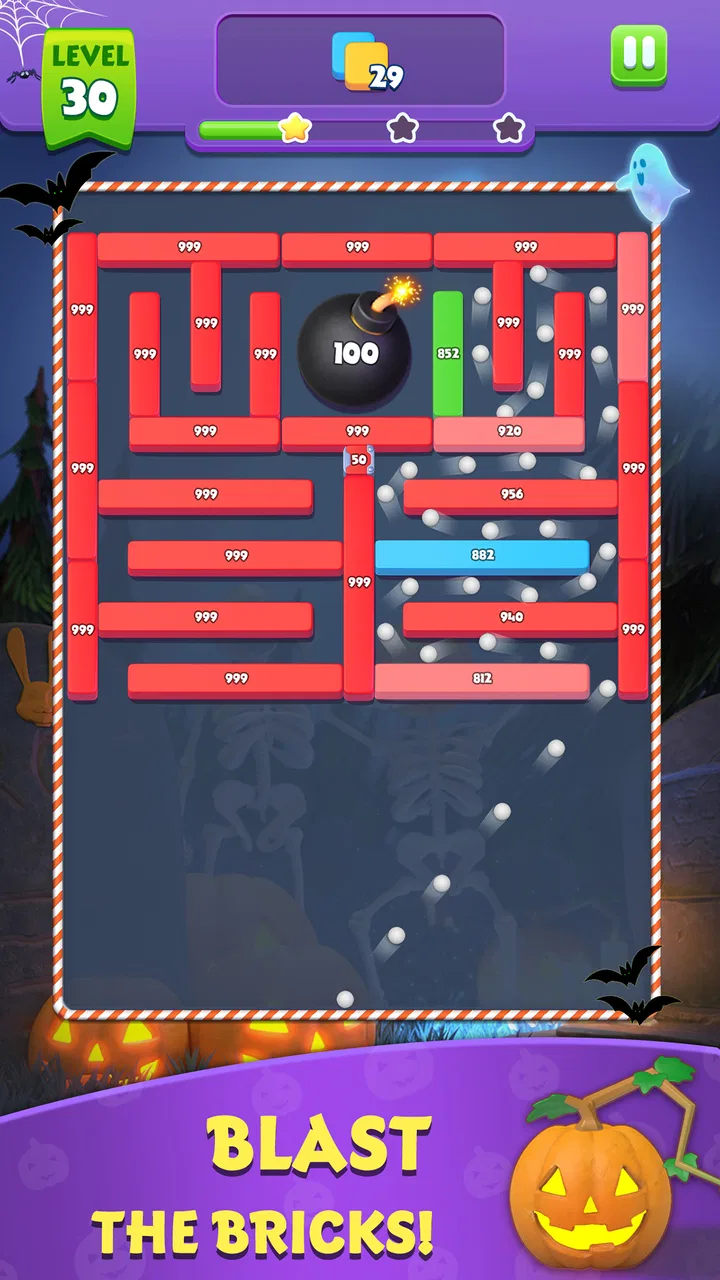
Brick Ball Blast: Ball Crusher
- 4.5
- Rating
- 1.00M
- Installs
- Free
- Price

 Analysis by App-foxy
I spent time with Brick Ball Blast: Ball Crusher as the kind of game you open when you want a quick arcade session rather than a long story or a complicated control scheme. Its basic idea is immediately clear: launch balls, break bricks, and keep the board under control. That simplicity is the main attraction, but it also means the quality of each shot matters more than the number of buttons on screen.
Developed by Neworld Games, this free arcade game is aimed at Everyone and runs on Android devices using version 7.0 or later. It has reached over a million installs, with a 4.5 average from around thirty-five thousand ratings. Those figures fit my impression: this is an accessible pick-up-and-play title with a broad audience, but one that still gives careful players enough room to improve their technique.
How the basic loop feels in everyday play
The first few rounds are easy to understand. I look at the arrangement of numbered or breakable blocks, choose an angle, and release the ball. Once the shot is moving, the important question is not simply which brick is closest. I need to think about the rebound, the return path, and where the ball will be useful after it has hit the first target.
You May Also Like

 Blood Strike: 2.5 Anniversary
Blood Strike’s Loadouts Turn Every Drop Into a Tactical Gamble
A close look at Blood Strike’s custom loadouts: how fast access to signature weapons reshapes its battle royale rhythm, rewards preparation, and narrows the gap between fights.

 Pandora - Music & Podcasts
Pandora’s Music Is Easy to Start, but Harder to Recover
Pandora’s strength is its low-effort path from a seed to a station. Its weak spot is how much confidence it asks you to place in connection, setup, and quiet recovery.

 8 Ball Pool
 Is Built on Rivalries, Rematches, and Routine
A close look at the rivalries, rematches, shared routines, and unanswered safety questions that turn a quick pool match into a persistent mobile community.

 Samsung Music
’s Quiet Strength Is Playing What You Already Own
Its reach comes less from spectacle than from dependable access to a personal library. That simplicity is both the app’s strongest retention engine and its ceiling.

 AccuWeather: Weather Radar
AccuWeather Review: A Quick, Clear Forecast for Everyday Decisions
For everyday plans, the best forecast is the one you can understand quickly. AccuWeather makes rain timing, radar, and local conditions easy to act on, with a few trade-offs.

 Hill Climb Racing
Why Hill Climb Racing Still Turns Crashes Into One More Run
A tiny car, a bumpy hill and one more upgrade: Hill Climb Racing keeps resurfacing because its simple chaos makes every near-miss feel personal.
More From Our News Desk



That makes the game feel different from a purely reflex-based arcade title. The launch is the decisive moment, while the rest of the action rewards prediction. A shot that clears one weak brick may be less valuable than a shot that enters a narrow gap and keeps bouncing through several targets. I found myself slowing down before each turn, even though the overall presentation encourages quick play.
My usual workflow is simple. I first scan for openings rather than immediately aiming at the strongest block. Then I look for a wall or edge that can extend the ball's route. Finally, I check where the ball is likely to return. This last step is easy to overlook, especially when several blocks are clustered together, but it often determines whether the next turn begins with a manageable board or an awkward one.
The most useful habit is to treat every launch as preparation for the next launch. Clearing the current row is satisfying, but preserving a good angle for the following turn is usually more important. When I played only for immediate damage, I often left a dangerous line of blocks near the bottom. When I planned the landing position, the same boards became much easier to control.
The game works well in short everyday situations. I can play a round while waiting for an appointment, take a few turns during a break, or return to it for a longer session without needing to remember a plot or a complicated objective. It is also suitable for someone who dislikes fast tapping because the challenge comes from choosing a trajectory rather than reacting to enemies in real time.
There is a small trade-off here. Players who want constant action may find the aiming phase slower than a conventional reflex arcade game. The appeal is strongest when I enjoy examining a board and making a deliberate choice. If I want dramatic levels, character progression, or a competitive match against another person, this is not the right type of arcade experience.
What I check before trying to play faster
I do not rush the opening turns. Early boards are useful for learning how the ball behaves, how much control I have over the angle, and how rebounds affect the next position. Instead of firing as soon as the path looks acceptable, I take a moment to compare a direct route with a banked route. The indirect option often creates more contacts and leaves fewer blocks untouched.
I also avoid focusing on a single brick simply because it has a high visible value. A difficult block may be worth attacking later if a different target can open a lane first. In practice, the best first shot is often the one that changes the shape of the board. Once a crowded section is opened, later launches become more predictable and less dependent on luck.
Another useful routine is watching the full return path. The first collision can look excellent while the eventual landing point is poor. I try to imagine the ball continuing beyond the most obvious rebound. This is especially helpful when the board contains a narrow channel: entering it from the right angle can produce several useful hits, while entering it slightly off-center may end the turn quickly.
For a new player, I would recommend repeating this process rather than chasing perfect results immediately. The controls are easy enough to understand without a tutorial-heavy approach, but the difference between a random shot and a planned shot becomes clear after a few rounds. The game rewards patience without demanding a large time commitment.
Settings and small choices worth checking
Before settling into longer sessions, I check the available in-game settings and the device's own sound controls. I prefer to reduce distractions when I am trying to study angles, while keeping enough feedback to know when a shot has finished. The ideal arrangement depends on whether I am playing casually in public or concentrating at home, so I treat this as a practical adjustment rather than a permanent setup.
I also pay attention to how the game feels in portrait or landscape use on my particular device, rather than assuming one arrangement will suit everyone. A comfortable grip matters because repeated aiming becomes tiring if I have to shift my hand to see the board clearly. This is a small point, but it affects accuracy more than many players expect during a long session.
The current version is 4.9.13, and the minimum Android requirement is 7.0. That makes it approachable for people using older compatible devices, although the experience can still vary with screen size and touch response. On a smaller display, I would be more careful with fine aiming; on a larger one, the board is easier to read, but holding the phone for many rounds may become less comfortable.
I would not choose a device setup based only on raw performance. This is not the kind of game where I need to prepare for demanding graphics or a complex control layout. A stable touch response and a screen that lets me judge narrow angles are more valuable. If a player regularly experiences accidental releases or struggles to see the lower part of the board, changing grip or display comfort may help more than chasing a faster phone.
The free entry point is another practical advantage. I can install it and decide whether the loop suits me without paying first. There are in-app purchases ranging from ninety-nine cents to ninety-nine dollars and ninety-nine cents per item, so I would review purchase controls before handing the phone to a child, even though the age classification is Everyone. The game is easy to try, but that does not mean every optional purchase is equally useful for every player.
Repeatable aiming patterns that improve consistency
Once I understood the basic loop, I started using repeatable patterns instead of improvising every turn. The first is the wall-bank approach: I aim for a side or upper boundary when a direct shot would stop too soon. The purpose is not simply to create a flashy rebound. It is to send the ball through a region where several blocks can be contacted before the ball returns.
The second pattern is opening a central lane. When the middle of the board is crowded, I look for the weakest point that can create a passage. A central opening gives later shots more options, while attacking only the outside edges can leave the main danger untouched. This is not a guaranteed solution, but it is a useful default when I cannot find a clearly superior angle.
The third is deliberately accepting a modest first hit to secure a better follow-up. I used to assume that the strongest visible impact was always best. In reality, a controlled route that ends in a useful position can outperform a powerful-looking shot that leaves the ball stranded near an unhelpful edge. This is one of the game's more interesting trade-offs: immediate damage and future control do not always point in the same direction.
I also try to identify the board's most dangerous unfinished area. If a block is close to the lower boundary, I give it priority even when another group offers more satisfying rebounds. This habit keeps me from becoming distracted by long chains. A large number of contacts feels productive, but survival depends on managing the blocks that threaten the next turn.
For someone playing during a short break, I would use a simple three-question check before each launch: where is the safest opening, where will the ball return, and which block must not be ignored? That routine takes only a few seconds and is more reliable than firing quickly. It also makes improvement measurable in a personal sense, because I can tell whether a failed turn came from a bad angle, poor target selection, or an overly optimistic rebound.
Compared with familiar brick-breaker alternatives, this game feels more focused on planning than on paddle movement. Traditional paddle-based titles often test constant positioning and reaction speed. Here, the main skill is selecting a route through a fixed arrangement. Players who enjoy angle puzzles may prefer this format, while fans of rapid paddle control may find it less energetic.
Where experienced play still meets limits
Good habits improve consistency, but they do not remove every limitation. The core interaction remains repetitive: aim, release, watch the chain of collisions, and prepare for the next board state. That repetition is relaxing for me in short sessions, yet it can feel narrow if I play continuously for too long. I would rather treat it as a compact arcade diversion than expect it to replace a deeper strategy game.
The reliance on trajectory also means that a small aiming error can have a large effect. A nearly correct angle may miss an opening, shorten the route, or leave a dangerous block in place. Players who prefer direct control over every movement may find this frustrating. The game asks me to commit to a shot and accept the result, which creates tension but also reduces the sense of moment-to-moment correction.
Another limit is the difference between understanding a good pattern and applying it on a changing board. A wall-bank that worked beautifully in one arrangement may be poor in another because the return path is blocked. I have to treat patterns as starting points, not automatic solutions. The strongest players are not repeating one trick blindly; they are recognizing when the board makes that trick unsafe.
I would also be cautious about playing only for long chains. Extended rebounds can be entertaining, but they may encourage me to ignore the board's overall shape. A shorter route that clears a threatening line can be strategically better. This is a useful boundary for advanced play: maximizing visible action is not always the same as maximizing control.
Players who need a rich narrative, character collection, social competition, or a large variety of control schemes should probably look elsewhere. Likewise, anyone who dislikes optional purchases may want to set spending limits before installing, since the game is free to start but includes paid items. For a relaxed arcade player, those points may be manageable; for someone seeking a fully self-contained premium experience, they may be decisive.
On the other hand, the simplicity is exactly why I can recommend it to people who normally avoid complicated games. There is no need to learn a large rulebook before the first useful decision. A child or casual player can understand the objective quickly, while an experienced player can refine shot selection and board management over time. The Everyone rating supports that broad accessibility, although younger players should still use the usual device purchase safeguards.
Who gets the most from this brick-breaking game
I think it is best for players who enjoy compact puzzles disguised as arcade action. It suits someone who wants a game that can be paused mentally between turns, a commuter looking for short sessions, or a fan of brick-breaking mechanics who prefers aiming over paddle control. It is also a good choice for improving visual planning because each turn encourages me to connect an angle with a future result.
It is less suitable for a player who wants every round to feel dramatically different. The central pleasure comes from mastering the same basic interaction, not from constantly discovering new systems. If I were choosing a game for a long evening with a strong sense of progression, I would compare it with a more feature-heavy alternative. If I wanted a quick board-clearing challenge, this one would be easier to recommend.
My practical advice is to play in short sets at first. After several turns, stop and identify which shots actually helped. Did the longest rebound improve the board, or did it merely look impressive? Did attacking the strongest block create an opening, or did it leave the lower area exposed? Asking those questions turns casual play into a repeatable learning process without making the game feel like homework.
Because the title is free, trying that routine costs nothing up front. I would still avoid buying anything until I knew whether the basic loop had lasting appeal. The purchase range is wide, and a player who only wants occasional sessions may never need an optional item. That is an important part of the recommendation: enjoy the core game first, then decide whether any extra spending genuinely changes your experience.
My verdict after settling into the rhythm
Brick Ball Blast: Ball Crusher succeeds because it keeps the rules clear while giving each shot a little more depth than the first glance suggests. I like that the game rewards planning without requiring a long session. The best moments come from finding a narrow route, opening a crowded section, and watching one carefully chosen launch solve several problems at once.
Neworld Games has made an approachable arcade game for Android users on version 7.0 and above, and the combination of a free starting point, an Everyone age rating, and a familiar brick-breaking idea makes it easy to sample. Its 4.5 average and more than a million installs also show that the format has found a substantial audience, though popularity does not change the fact that the loop is intentionally focused and repetitive.
I would recommend it to a friend who likes thoughtful arcade sessions, especially someone who enjoys improving through small adjustments rather than unlocking a complicated collection of systems. I would not recommend it to a friend looking for story, multiplayer competition, or constant high-speed reactions. For me, it works best as a reliable pocket game: simple to start, satisfying when I plan well, and honest about the limits of its narrow design.
The final test is whether I feel tempted to make one more careful launch instead of merely tapping through turns. With this game, I usually do. That is enough to make it a worthwhile free arcade download for the right player, provided you approach it as a game of angles, patience, and board control rather than expecting a larger adventure.
FAQs for Brick Ball Blast: Ball Crusher
01What is Brick Ball Blast: Ball Crusher?
Brick Ball Blast: Ball Crusher is a casual arcade game centered on breaking numbered blocks with bouncing balls. You aim, launch, and try to clear as many bricks as possible before they reach the bottom of the screen. The gameplay is easy to understand, but later stages require careful angle selection, planning, and effective use of power-ups to create larger chain reactions.
02How do you play Brick Ball Blast: Ball Crusher?
To play, drag your finger to adjust the launch direction and release it to fire the balls toward the bricks. Each brick usually requires a certain number of hits before it disappears, so choosing the right angle is important. Bouncing shots off walls can help reach difficult areas, collect additional balls, and destroy several targets during a single turn.
03Is Brick Ball Blast: Ball Crusher free to download and play?
The game can generally be downloaded and played without an upfront purchase, making it accessible to casual players. However, free games may include advertising, optional in-app purchases, or both. These extras can sometimes provide bonuses, remove ads, or speed up progress. Before downloading, check the current store listing for pricing, advertisements, and purchase details.
04Does Brick Ball Blast: Ball Crusher require an internet connection?
Basic brick-breaking gameplay may work without a continuous internet connection, which makes the game suitable for short sessions while traveling or when mobile data is unavailable. Nevertheless, some features—such as advertisements, rewards, cloud-related services, updates, or promotional events—may require internet access. Availability can vary by device and game version, so offline functionality should be tested after installation.
05Is Brick Ball Blast: Ball Crusher suitable for children and casual players?
The controls are simple, the rules are easy to learn, and sessions can usually be completed in a short time, making the game approachable for both children and casual players. Even so, parents should review the age rating, advertising, and in-app purchase settings before allowing younger users to play. Difficulty can also increase gradually, requiring patience and strategic aiming.
Pros
- Simple one-touch controls make it easy to start playing immediately.
- Short levels fit well into quick gaming sessions.
- Brick-breaking physics feel satisfying when combos build up.
- Power-ups add variety and help clear difficult brick formations.
- Works well for casual players who enjoy relaxing arcade games.
Cons
- Later stages can become repetitive once familiar brick patterns return.
- Some power-ups may feel unbalanced during tougher levels.
- Progress can depend heavily on favorable ball ricochets.
- Ads may interrupt the experience
- especially after failed attempts.
- The game offers limited depth for players seeking competitive features.

Brick Ball Blast: Ball Crusher
Gallery